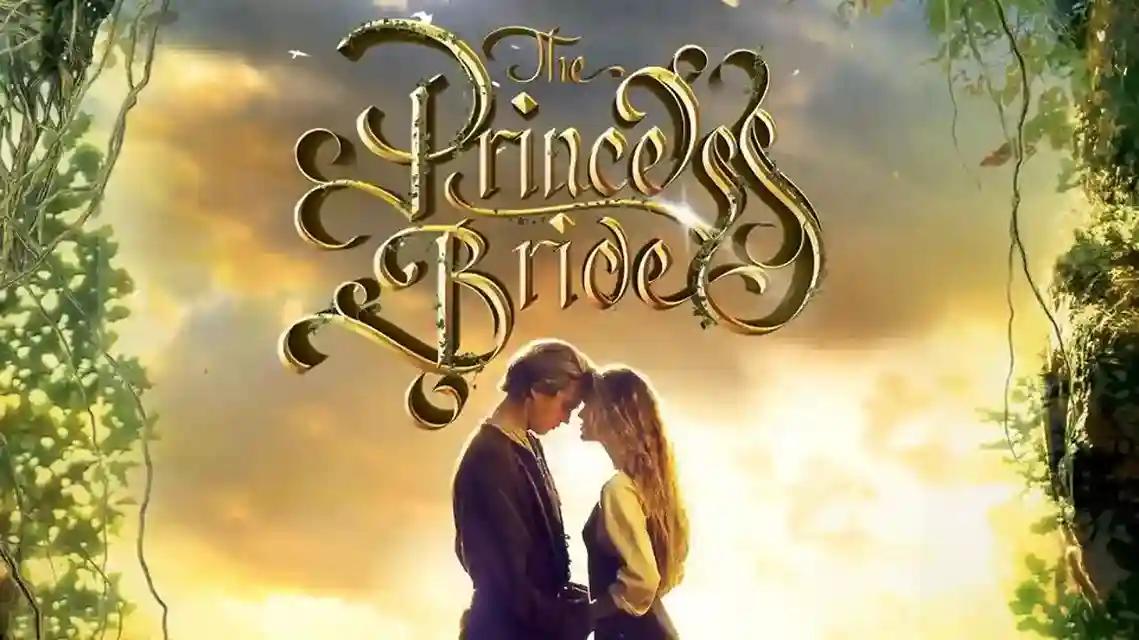
Some movies arrive as instant classics. Others sneak up on you, gaining weight and meaning with every passing year. The Princess Bride (1987) belongs to a third, rarer category: the film that seems almost deliberately misunderstood upon release, only to be embraced later as an essential piece of cinematic magic. Directed by Rob Reiner from a screenplay by William Goldman (adapting his own 1973 novel), it defied easy marketing. Was it a comedy? A romance? A swashbuckling adventure? A satire of fairy tales? The answer, of course, is all of the above—and something stranger and more wonderful than any single label can capture.
The film opens in a child’s bedroom. A young boy, Fred Savage, lies sick in bed. His grandfather, played with gentle authority by Peter Falk, arrives to read him a story. The boy groans. He wants something with “fights and torture and true love.” His grandfather smiles and opens a worn book. Thus begins the tale of Buttercup, a beautiful farm girl in the fictional kingdom of Florin, and Westley, the lowly farmhand who loves her. Westley’s only response to Buttercup’s endless demands is a quiet “As you wish.” Eventually she understands: he means I love you.
That small, perfect exchange sets the tone for everything that follows. The Princess Bride understands that true romance is not about grand gestures but about quiet devotion. It also understands that true romance is hilarious, absurd, and often interrupted by violent men in masks.
When Westley sails away to find his fortune and is reportedly killed by the Dread Pirate Roberts, a devastated Buttercup agrees to marry the scheming Prince Humperdinck (Chris Sarandon, wonderfully oily). Before the wedding, she is kidnapped by a trio of incompetent outlaws: the boastful Sicilian Vizzini (Wallace Shawn), the Spanish swordsman Inigo Montoya (Mandy Patinkin), and the gentle giant Fezzik (Andre the Giant). A mysterious masked man in black pursues them. The chase is on.
What makes The Princess Bride unforgettable is not its plot—which is deliberately simple—but its execution. The sword fight between Inigo and the man in black is a masterclass in choreography and character. These two exhausted, bleeding men pause mid-duel to compliment each other. “I admit it, you are better than I am,” says Inigo. “Then why are you smiling?” asks the masked man. “Because I know something you do not know. I am not left-handed.” The man in black switches his sword to his right hand. The fight resumes. It is thrilling, funny, and oddly moving.
The dialogue has entered the cultural bloodstream. “Inconceivable!” “My name is Inigo Montoya. You killed my father. Prepare to die.” “Anybody want a peanut?” “Have fun storming the castle!” These lines are now shorthand for wit and warmth. But they work because the actors deliver them with total sincerity. Mandy Patinkin, in particular, gives Inigo a tragic depth. His quest for revenge is not a joke. When he finally confronts the six-fingered man who murdered his father, the repeated vow becomes a genuine cry of pain and liberation. Patinkin has said he used the role to grieve his own father’s death from cancer. That raw emotion elevates the entire film.
Andre the Giant, a professional wrestler with limited acting experience, is a revelation as Fezzik. He is a giant who does not want to be feared. He wants to rhyme. He wants a friend. His quiet dignity and physical gentleness make every scene he inhabits better. Wallace Shawn, meanwhile, turns Vizzini into a masterpiece of self-delusion. He is a man who believes he is brilliant because he speaks loudly and uses long words. His fall is inevitable and hilarious.
Robin Wright, in one of her earliest roles, brings more to Buttercup than a typical damsel. She is stubborn, fierce, and willing to throw herself off a cliff for the man she loves. And Cary Elwes as Westley is the perfect fairy-tale hero: handsome, clever, and utterly devoted, but also capable of being tortured, thrown into a pit, and carried around unconscious. The film never lets him forget that adventure is mostly discomfort and luck.
The framing device—the grandfather reading to the boy—is what makes the whole thing work. The boy starts as a cynical, modern kid who scoffs at kissing books. But as the story unfolds, he leans in. He cares about the Fire Swamp and the rodents of unusual size. By the end, when the grandfather closes the book, the boy asks him to read it again tomorrow. That is the film’s quiet thesis: stories matter. They connect generations. They turn cynics into believers.
The Princess Bride was not a blockbuster in 1987. It found its audience on home video, growing decade by decade into a beloved classic. Today it sits at 97% on Rotten Tomatoes and is preserved in the National Film Registry. But numbers and awards miss the point. Watch it with a child or a grandparent, and you will see its real power. It is a movie about love, loss, revenge, and the simple joy of a story well told. And that, as you wish, is inconceivably rare.